Skip to Main

Join Aspen Rewards - FREE SHIPPING & DISCOUNTS

An Analytical Approach to Evidence: Text, Problems, and Cases, Eighth Edition

Authors
  • Ronald J. Allen
  • David S. Schwartz
  • Michael S. Pardo
  • Alex Stein
  • Deborah Tuerkheimer
Series / Aspen Casebook Series
Description
Table of contents
Preface

Buy a new version of this textbook and receive access to the Connected eBook with Study Center on Casebook Connect, including academic lifetime access to the online ebook with highlight, annotation, and search capabilities. Access also includes practice questions, an outline tool, and other helpful resources. Connected eBooks provide what you need most to be successful in your law school classes.

An Analytical Approach to Evidence: Text, Problems, and Cases, Eighth Edition is a problem-based Evidence casebook that presents the Federal Rules of Evidence in context, illuminates the rules’ underlying theories and perspectives, and provides a fully updated and systematic account of the law in a student-friendly format. The material is accompanied with straightforward and systematic explanations. Lively discussion and interesting problems (rather than numerous appellate case excerpts) engage students in understanding the principles, policies, and debates that surround evidence law. The book also contains self-assessment sections in each chapter that teach students how to identify and resolve legal issues and succeed in the final exam. To sum up: this book stands out as “all in one." It gives students of evidence an up-to-date comprehensive account of the law. It explains complex evidentiary issues in a straightforward and systematic fashion; and it also tells students what their exam will look like and how to succeed in it. 

New to the Eighth Edition:

  • Thorough reworking of material treating FRE 412-415
  • Substantial updates to the Confrontation Clause material to account for new Supreme Court cases
  • Streamlined material related to expert testimony and added discussion of amendment to FRE 702
  • Discussion of new FRE 107 governing use of illustrative aids
  • Explanation of the new rule rendering admissible party-admission hearsay statements in the context of relationships between principals and agents and predecessors and successors in interest
  • Examination of the novel Supreme Court decision in Diaz v. United States, 602 U.S. _____ (2024), which affirmed the admissibility of an expert testimony concerning drug traffickers' modus operandi
  • Streamlined and shortened discussion of evidentiary privileges with the primary focus on the core privileges
  • Streamlined, shortened, and updated discussion of the hearsay exceptions in Rules 803, 804, and 807
  • Explanation and discussion of the hearsay exception for statements against interest in light of amended Rule 804(3)
  • Explanation and discussion of impeachment with prior statements in light of amended Rule 613 

Benefits for instructors and students:

  • An opening case file introduces students to the process of analyzing evidence in terms of the essential elements of a legal dispute, serving as an effective introduction to much of the course to follow
  • A wide range of real-world problems exposes students to the depth and complexity of the Rules of Evidence
  • Every chapter addresses basic rules interpretation, essential policy, and connects theory to practice
  • Assessment problems (modeled on exam questions) are provided at the end of each chapter, including answers with explanations
Read More
Table of contents

Summary of Contents


Contents 
Preface 
Acknowledgments 

Why Study Evidence? A Student’s Preface 
Special Notice on Citations 
Chapter 1. Evidence in Context: The Theory of the Case 
Chapter 2. The Process of Proof: How Trials Are Structured 
Chapter 3. Relevance, Probative Value, and the Rule 403 Dangers 
Chapter 4. Foundation 
Chapter 5. The Character, Propensity, and Specific-Acts Rules 
Chapter 6. The Other Relevance Rules 
Chapter 7. The Impeachment and Rehabilitation of Witnesses 
Chapter 8. The Hearsay Rule 
Chapter 9. Lay Opinions and Expert Witnesses 
Chapter 10. The Process of Proof in Civil and Criminal Cases:
Burdens of Proof, Judicial Summary and Comment,
and Presumptions 
Chapter 11. Judicial Notice 
Chapter 12. Privileges 


Table of Cases 
Table of Authorities 
Index 

Read More
Professor Materials
Please sign in or register to view Professor Materials. These materials are only available for validated professor accounts. If you are registering for the first time, validation may take up to 2 business days.
About the authors
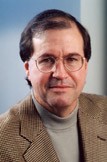
Ronald J. Allen
Northwestern University

Professor Allen is the John Henry Wigmore Professor of Law at Northwestern University, in Chicago, IL. He did his undergraduate work in mathematics at Marshall University and studied law at the University of Michigan. He is an internationally recognized expert in the fields of evidence, procedure, and constitutional law. He has published seven books and approximately one hundred and sixty articles in major law reviews.

The New York Times referred to him as one of the nation’s leading experts on evidence and procedure. He has been quoted in national news outlets hundreds of times, and appears regularly on national broadcast media on matters ranging from complex litigation to constitutional law to criminal justice.

Professor Allen began his career at the State University of New York, and has held professorships at the University of Iowa and Duke University prior to coming to Northwestern. He has lectured on his research at distinguished universities across the world, among them Columbia University, Cornell University, University of Chicago, University of Virginia, University of Pennsylvania, University of Michigan, Duke University, Oxford University, University of London, Leiden University, the Royal Netherlands Academy of Arts and Sciences, University of Edinburgh, University of British Columbia, the University of Paris (Sorbonne), Parma University, Turin University, Pavia University, University of Adelaide, Australia, and Victoria University of Wellington, New Zealand, and UNAM, Mexico City.

In 1991, he was the University Distinguished Visiting Scholar at the University of Adelaide, South Australia. Three of his books has been translated into Chinese by the Ministry of Education of the People's Republic of China, and he has been invited to China for a series of lectures in the summer of 2004 and the spring of 2005. He has also been invited to lecture by the governments of Mexico and Trinidad & Tobago. His articles have been translated into both Spanish and Portuguese and published in book form.

For the last twenty years, his research has focused on the nature of juridical proof. He has been involved as a consultant on numerous cases involving complex litigation in the United States and abroad. He is a member of the American Law Institute, has chaired the Evidence Section of the Association of American Law Schools, and was Vice-chair of the Rules of Procedure and Evidence Committee of the American Bar Association’s Criminal Justice Section.

He has served as a Commissioner of the Illinois Supreme Court, assigned to the Attorney Registration and Disciplinary Commission. He has served on the Boards of the Constitutional Rights Foundation-Chicago, and the Yeager Society of Scholars of Marshall University and on various boards and committees of civic and cultural institutions in Chicago.

David S. Schwartz
University of Wisconsin

David Schwartz joined the UW Law faculty in fall 1999, after 12 years of law practice in which he specialized in employment discrimination and civil rights litigation. For the three years just prior to joining the Law School faculty, Prof. Schwartz was Senior Staff Attorney at the American Civil Liberties Union of Southern California, in Los Angeles. Previously, Prof. Schwartz was in private practice in San Francisco, representing plaintiffs in employment cases. After graduating law school, Prof. Schwartz clerked for the Honorable Betty B. Fletcher of the U.S. Court of Appeals for the Ninth Circuit.

Professor Schwartz currently teaches Civil Procedure I, Evidence, and Constitutional Law, and he has also taught Civil Rights Litigation, Employment Law, and Remedies. His scholarly interests currently focus on constitutional law and the civil litigation system.

Michael Pardo
Professor of Law
Georgetown University

Michael S. Pardo’s teaching and scholarship focus on evidence, criminal procedure, civil procedure, philosophy of law, and law and neuroscience. His current research focuses on philosophical issues related to evidence, procedure, and legal proof.

Professor Pardo has authored two books and more than fifty articles, essays, and book chapters. His books include An Analytical Approach to Evidence (6th edition, Aspen Publishing, 2016, with Allen et al.) and Minds, Brains, and Law (Oxford University Press, 2013, with Patterson). He is also a co-editor of Philosophical Foundations of Law and Neuroscience (Oxford University Press, 2016, with Patterson). His articles have been published in distinguished journals such as Vanderbilt Law Review, William & Mary Law Review, Boston College Law Review, Illinois Law Review, Northwestern Law Review, Texas Law Review, Iowa Law Review, Legal Theory, Law & Philosophy, Jurisprudence, Neuroethics, Criminal Law & Philosophy, and the Journal of Legal Studies, among others.

Before coming to Georgetown, Professor Pardo was on the faculty at the University of Alabama School of Law, where he was the Henry Upson Sims Professor and a founder and co-director of the law school’s Program on Cross-Disciplinary Legal Studies. He has also served as Chair of the Association of American Law Schools Section on Evidence.

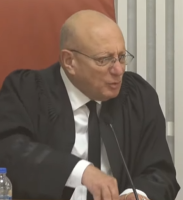
Alex Stein
Justice
Israel Supreme Court

Justice Alex Stein joined the Israel Supreme Court in 2018. Since then, he has delivered a number of decisions shaping Israeli law in multiple areas, including evidence. He was appointed to the Court after a long and successful academic career during which he served as a Professor of Law and Vice-Dean at the Hebrew University of Jerusalem Faculty of Law, as well as a Professor of Law at Cardozo and Brooklyn Law Schools in New York City, and taught as a Visiting Professor of Law at Harvard, Yale, and Columbia law schools, among others.

Justice Stein is the author of five books, two of which – Foundations of Evidence Law (Oxford University Press, 2005) and Tort Liability under Uncertainty (Oxford University Press, 2001) (with Ariel Porat) – are considered path-breaking and widely discussed in the literature. He also published over eighty articles, many of which have appeared in the world’s leading journals such as Harvard Law Review, Columbia Law Review, University of Pennsylvania Law Review, Michigan Law Review, Virginia Law Review, Georgetown Law Journal, Northwestern University Law Review, Cornell Law Review, Texas Law Review, Vanderbilt Law Review, and Oxford Journal of Legal Studies.

While on the bench, Justice Stein continues to contribute to legal scholarship by publishing books and articles. He co-edited the Oxford University Press anthology, Philosophical Foundations of Evidence Law (2021), and published an article on Probabilism in Legal Interpretation in the Iowa Law Review.

Justice Stein’s areas of expertise include evidence, torts, general legal theory, and economic analysis of law. He has been invited to speak in these areas at academic events and judicial conferences across the world, and his opinions have been cited by international media outlets including New York Times, Frankfurter Allgemeine Zeitung, and Nature.

Deborah Tuerkheimer

Deborah Tuerkheimer joined the Northwestern Law faculty in 2014 after serving as a professor at DePaul University College of Law since 2009 and the University of Maine School of Law since 2002. Professor Tuerkheimer received her undergraduate degree from Harvard College and her JD from Yale. She teaches and writes in the areas of criminal law, evidence, and feminist legal theory. Her book, CREDIBLE: Why We Doubt Accusers and Protect Abusers, was published in October 2021. In 2014, Oxford University Press published her book, Flawed Convictions: “Shaken Baby Syndrome” and the Inertia of Injustice. She is also a co-author of the casebook Feminist Jurisprudence: Cases and Materials and the author of numerous articles on sexual violence and domestic violence. After clerking for Alaska Supreme Court Justice Jay Rabinowitz, she served for five years as an Assistant District Attorney in the New York County District Attorney's Office, where she specialized in domestic violence prosecution. In 2015, Tuerkheimer was elected to the American Law Institute, an esteemed group of judges, lawyers, and legal scholars dedicated to the development of the law.

Product Information
Edition
Eighth Edition
Publication date
2026-02-25
Copyright Year
2026
Pages
1030
Print + eBook
9798892079020
eBook
9798892079037
LLPOD
9798892079051
Subject
Evidence
Select Format Show Hide
Select Format Hide
Are you an educator?