Skip to Main

Join Aspen Rewards - FREE SHIPPING & DISCOUNTS

Examples & Explanations
Overview

What is Examples & Explanations?

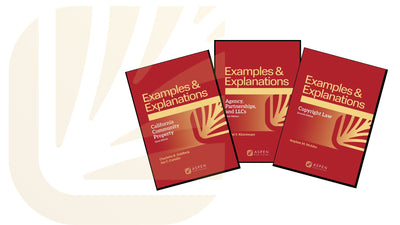
A popular classroom prep tool of successful students and professors alike, Examples & Explanations (E&E) gives you a different angle on your casebook and in-class lectures. Each title pairs hypothetical questions with detailed explanations so you can test your understanding and compare your own analysis.

BUILT TO TEST YOUR UNDERSTANDING

Work through hypothetical questions matched with detailed explanations, then compare your own analysis against the answer. Diagrams and other visual aids reinforce the material throughout, so you can see how the rules apply before you're tested on them yourself.

Benefits

Why Consider Examples & Explanations

Examples & Explanations offer many benefits to students, including:

  • Learn legal concepts through clear explanations and practical examples.
  •  Strengthen understanding by applying rules to realistic fact patterns.
  •  Bridge the gap between theory and legal analysis.
  •  Build confidence with guided practice and self-assessment opportunities.

Overview

Everyone hits a wall where re-reading doesn't help. E&E fills the gap with hypothetical questions and
detailed expert explanations — building real comprehension, not just familiarity.

Frequently Asked Questions

Is E&E tied to a specific casebook?

No — Examples & Explanations are designed to work alongside any casebook. The questions and explanations are based on the underlying legal doctrine, not on the specific cases your professor assigned. That makes E&E flexible for any section.

When should I use E&E — during or before class?

Both. Read the relevant E&E chapter alongside your assigned cases to reinforce each concept during the semester, then work back through the examples as active practice before exams. Because E&E is organized around legal doctrine rather than a single casebook, it fits neatly into any professor's syllabus.